Cavities(Tooth Decay): Defination, Types, Symptoms Causes, Stages, Risk Factor Treatment and Prevention
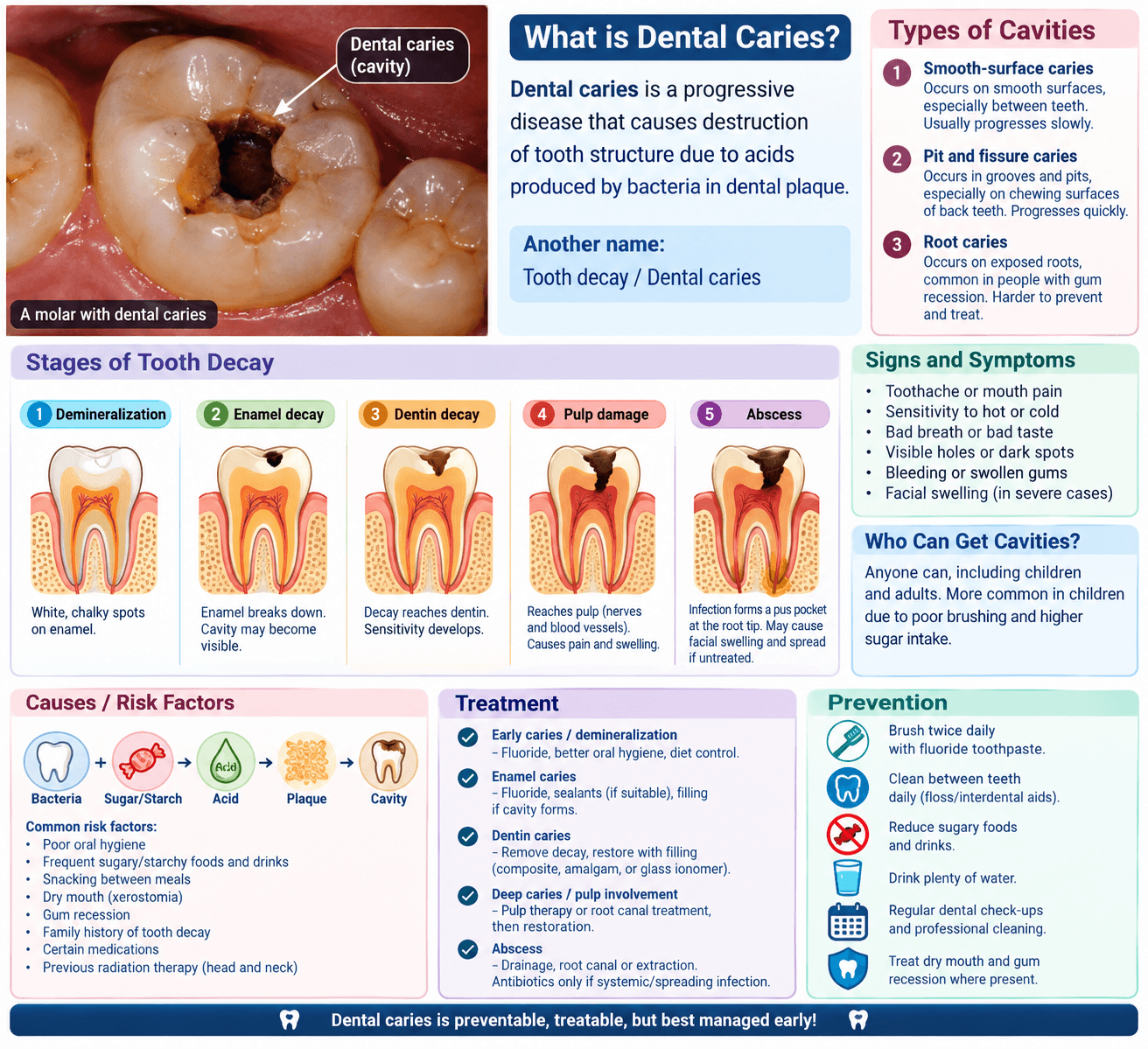
Dental caries is a progressive disease that causes destruction of tooth structure due to acids produced by bacteria in dental plaque.

By Zainab Abubakar
Sep 21, 2026, 1:53 PM · 3 min read
🦷 Dental Caries (Cavities)
Definition
A cavity is a hole or damage in a tooth caused by tooth decay (dental caries). It occurs when acids produced by bacteria in dental plaque gradually destroy the tooth’s enamel and deeper layers.
Another name: Dental caries / tooth decay.
Types of Cavities
Smooth-surface caries – occurs on the smooth surfaces of teeth, especially between teeth. It usually progresses slowly and can sometimes be reversed at the early stage with good oral hygiene.
Pit and fissure caries – occurs in the grooves and pits on the chewing surfaces of teeth, especially posterior teeth. It can progress rapidly.
Root caries – occurs on exposed tooth roots, commonly in adults with gingival recession. It can be difficult to prevent and treat.
Who Can Get Cavities?
Anyone can develop cavities, including children and adults. Risk is increased by:
Poor oral hygiene
Frequent intake of sugary/starchy foods and drinks
Inadequate brushing and flossing
Dry mouth
Gum recession
Family history of tooth decay
Previous radiation therapy to the head and neck
Signs and Symptoms
Early decay may have no symptoms. As it progresses, symptoms may include:
Toothache or mouth pain
Sensitivity to hot or cold
Bad breath or bad taste
Visible white, brown or black spots
Bleeding or swollen gums
Facial swelling
Pain when eating
🦷 Stages of Tooth Decay
1. Demineralization
Minerals are lost from the enamel, producing white/chalky spots.
2. Enamel decay
The enamel continues to break down and a visible cavity may develop.
3. Dentin decay
Decay reaches the softer dentin beneath the enamel. Sensitivity commonly develops.
4. Pulp damage
Decay reaches the pulp, which contains nerves and blood vessels. This can cause severe toothache, inflammation and swelling.
5. Dental abscess
Untreated decay can cause infection and a pus-filled abscess around the tooth root. It may cause severe pain, facial swelling and swollen lymph nodes. In serious cases, infection can spread to other parts of the body.
How Cavities Develop
Sugar/starch → bacteria feed on it → acids are produced → plaque forms → acids attack enamel → mineral loss → cavity develops.
Risk Factors
Poor oral hygiene
Frequent sugary/starchy foods and drinks
Snacking frequently between meals
Dry mouth (xerostomia)
Certain medications
Gum recession
Family history of dental caries
Previous head/neck radiation therapy
🦷 Treatment of Dental Caries
Treatment depends on the stage and severity of the caries.
Early caries / demineralization
Fluoride toothpaste or professional fluoride treatment.
Improve brushing and oral hygiene.
Reduce frequent sugary foods and drinks.
Regular dental monitoring.
Caries limited to enamel
Fluoride treatment where appropriate.
Pit and fissure sealants for suitable pits and fissures.
If a cavity has formed, restore the tooth.
Caries involving dentin
Remove the infected/decayed tooth structure.
Restore the tooth with an appropriate filling material, such as composite, amalgam, or glass ionomer where indicated.
Deep caries approaching the pulp
Vital pulp therapy such as indirect/direct pulp treatment may be considered when the pulp is still healthy or capable of healing.
The tooth is then restored with an appropriate restoration.
Pulp involvement / irreversible pulpitis
Root canal treatment followed by appropriate restoration/crown when indicated.
Extraction may be considered if the tooth cannot be predictably restored.
Dental abscess
Drainage of the abscess when indicated.
Treat the source with root canal treatment or extraction.
Antibiotics are generally reserved for cases with systemic involvement or spreading infection, rather than being used routinely for a localized dental abscess.
PREVENTION
Brush teeth twice daily with fluoride toothpaste.
Clean between the teeth regularly with floss or other interdental aids.
Reduce frequent sugary snacks and drinks.
Maintain regular dental check-ups and professional cleaning.
Drink adequate water.
Manage dry mouth where present.
Treat gum recession and other oral conditions early.
In one sentence: Dental caries is a progressive disease caused mainly by acids produced by plaque bacteria, which destroy tooth structure and can eventually lead to pulp infection and dental abscess if untreated.
Get the biggest stories in your inbox
A concise morning briefing, curated by Chronicle editors.